
A Proven 5-Step Approach for Upskilling Your Team in Gen AI

Most Internal Audit and SOX teams are starting 2026 with a common goal: Moving beyond experimentation to operationalize and scale Gen AI use across the team and audit lifecycle.
That’s exactly why helping our members increase AI competency and adoption is one of the Internal Audit Collective’s key 2026 priorities.
We achieved a ton in 2025: Founding and sustaining three Gen AI working groups (Internal Audit use cases, SOX use cases, and governance). Establishing our Gen AI Prompt Library. Publishing the first of three eBooks sharing member-developed Gen AI how-to guidance and ready-to-deploy prompts.
But driving real results with Gen AI is a long game.
That’s why we’ve got plenty more how-to guidance coming — all based on what’s working for the teams who are helping to lead the Gen AI charge for Internal Audit.
During a December Internal Audit Collective roundtable, several leaders shared their proven strategies for advancing team-wide Gen AI competency and use.
Their ideas offer a solid five-step blueprint for Internal Audit and SOX teams of any size.
Many of these recommendations originated with Internal Audit leader and Internal Audit Collective AI Advisory Committee member Joe Earl, who generously shared his team’s multi-pronged approach. (Joe, thank you for your continued leadership and inspiration!)
1. Create and Use a Gen AI Prompt Library
Develop a Gen AI prompt library and make it available to everyone on your team.
A shared prompt library is a crucial foundation for:
- Providing ready access that encourages regular use.
- Ensuring prompt quality and consistency, reducing variability and supporting effective governance and risk management.
- Increasing efficiency and scalability — no need to start from scratch.
Joe’s team’s library, however, includes a super-important addition: Instructions that detail WHEN and HOW each prompt should be used within the audit lifecycle.
Haven’t started your Gen AI prompt library yet? Kick it off with these 20 proven prompts that were developed and QA’d by members of the Internal Audit Collective.
2. Encourage and Track Gen AI Use on Every Project
As the old saying goes, you can’t manage what you don’t monitor.
So, make managers responsible for tracking — and championing — Gen AI prompt use by staff, seniors, and supervisors.
- Record when/how the prompt was used.
- Collect/document feedback on prompt effectiveness.
- Consider developing KPIs to enable identification of trends and leading practices over time.
- Aggregate results and impact across audit projects.
Also, consider how you can incentivize ongoing usage, including:
- Recognizing and/or awarding notable achievements (e.g., highest usage levels, most feedback provided, most significant improvements, most new prompts created).
- Integrating Gen AI usage in annual performance goals.
3. Regularly Review and Discuss Gen AI Usage
Share and discuss Gen AI usage metrics, results, and impact during weekly or biweekly team or departmental meetings.
- Talk about what is and isn’t working.
- Celebrate key successes.
- Recognize “mistakes” as vital learning opportunities.
- Set an expectation for incremental improvement over time.
4. Offer Regular Gen AI “Prompt Practice” Office Hours
Host regular (weekly or biweekly) “prompt practice” office hours to teach, practice, and troubleshoot individual prompts.
Appoint a leader or strong team member to lead each session.
During these hour-long sessions:
- Have the session leader spend the first 5–10 minutes performing a live demo of the prompt, sharing their screen and talking through key considerations.
- Use the remaining 50 minutes to give everyone on the call the opportunity to try the prompt on their own, having them share their questions and feedback live.
- If feasible/appropriate, encourage the use of different Gen AI tools, enabling different users to compare notes on challenges, outcomes, and overall effectiveness.
- Set the tone that errors, troubleshooting, and ongoing improvement are integral to Gen AI, helping deflect any hesitations about being transparent with problems and questions.
- Have the session leader answer questions and troubleshoot users’ issues live, with the goal that everyone leaves confident that they know when/how to use the prompt.
These office hours have been a real game-changer for Joe’s team, embedding the time, practice, and guidance his team needs to use Gen AI efficiently, effectively, and securely.
5. Communicate Your Upskilling Plan to Organizational Leadership
Ensuring ongoing progress requires maintaining this competency improvement structure over time, giving your team critical bandwidth to practice Gen AI prompts and start using them in their work.
That requires dedicating more time to competency development in 2026 — and less to project work.
That’s why it’s essential to communicate your Gen AI upskilling plan to your CFO, CEO, Audit Committee Chair, and other key stakeholders.
If leadership needs convincing, build your business case.
Share initial successes that showcase how Internal Audit’s investments in operationalizing and scaling Gen AI will benefit the entire organization.
See Section One of our Gen AI for Internal Audit eBook for more tips on overcoming concerns about budget/cost, Gen AI risks, and other common stakeholder questions.
THE LAST WORD: Create a Gen AI Culture That Allows Time, Incentives, and Permission to “Fail”
This multi-pronged approach has helped Joe’s team be hugely successful in implementing Gen AI. These efforts provide critical foundations for success because:
- They’re carving out time. The regular “prompt practice” office hours embed time for experimentation and knowledge-sharing, helping practitioners feel ready to use Gen AI prompts in their day-to-day work. Notably, Joe’s team is also adding more hours to their audit program, ensuring that teams feel they have time for Gen AI’s inevitable learning curve.
- They’re destigmatizing “failure.” By setting the expectation that failures and mistakes are an inevitable part of the process, they’re allowing practitioners important space for experimenting, learning, and being transparent about their challenges.
- They’re incentivizing usage. They’re providing critical support (e.g., prompt libraries, office hours) and adding gamification, recognition, and rewards, all of which encourage ongoing use. They’re establishing and reinforcing accountability by tracking and regularly sharing usage metrics. They’re also getting more team members in position to help lead the Gen AI charge.
That’s why these same ideas inspired how the Internal Audit Collective will approach Gen AI knowledge-sharing in 2026. To start, we will:
- Build out our member-only Gen AI Prompt Library.
- Finalize/share more prompts and Gen AI governance guidance in our next two Gen AI eBooks.
- Host weekly “Prompt Practice” Office Hours” throughout Q1, having prompt developers demo and troubleshoot Gen AI prompts for Internal Audit Collective members.
- Commit our AI Advisory Committee to shaping future topics and deeper use cases.
- Develop a system for tracking AI prompt usage by collective members, helping us offer a wider view on the prompts that are and aren’t working in different parts of the audit lifecycle.
- Continue our Gen AI roundtable series (SOX, Internal Audit, and Gen AI governance), ensuring that discussions are responsive to members’ most pressing needs and questions.
- Use our blog to address frequently asked questions about using Gen AI.
If your team is aiming to improve its Gen AI game in 2026, why not join us? The Internal Audit Collective is dead serious about helping the profession level up in Gen AI. Get the front-row seat that will help you drive meaningful results and impact faster and more confidently.

Recent Articles

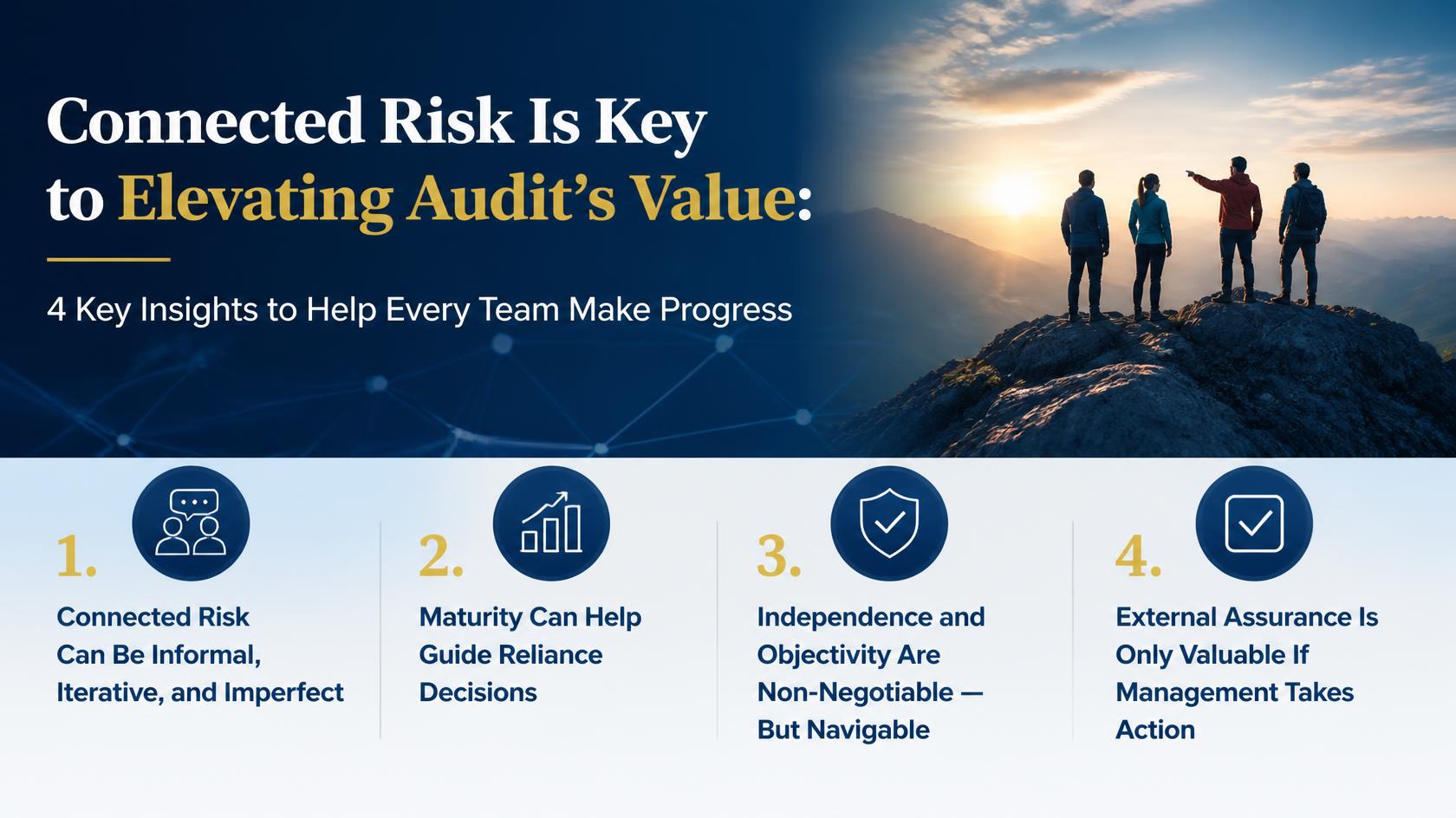
Connected Risk Is Key to Elevating Audit’s Value: 4 Key Insights to Help Every Team Make Progress

Want to be updated as new blog posts are released? Subscribe to our newsletter.
Join 1K+ readers of The Enabling Positive Change Newsletter for tips, strategies, and resources to improve your approach to Internal Audit and SOX compliance.