
How the Art of Small Talk Can Help You Build Trust and Improve Your Professional Relationships

Internal Audit leaders are still struggling to shake the “police” reputation.
When I recently surveyed 114 CAEs about Internal Audit leadership, asking for their “single biggest barrier to being recognized as a strategic leader by your organization’s senior business leaders, “perception of Internal Audit as COMPLIANCE/POLICE vs. a strategic partner” was the #1 response.
The other top-ranked responses tell the same story:
- Business leaders don’t understand Internal Audit’s role, capabilities, and value (#2)
- Internal Audit lacks access, visibility, or inclusion in strategic conversations (#3), or trust and credibility with senior leaders (#4)
- Internal Audit is hindered by “legacy perceptions, culture, and historical baggage” (#5)
We’ll look at these barriers and how to overcome them in an upcoming article. Today, we’re spotlighting an underappreciated tool we all have in our toolbox: The art of small talk, which is actually a vital tool for shedding our “police” reputation.
This article and an August 2026 webinar were inspired by a conversation I had with Josh Lowy, a Fortune 200 SOX leader and Internal Audit Collective member. As a remote worker, Josh thinks a ton about how to help himself and his team build and strengthen stakeholder relationships. We realized that getting comfortable having casual conversations with auditees and other stakeholders — aka “making small talk” — has become more important for relationship-building in the modern workplace.
Josh was actually my first client at EY. Back then, small talk helped us quickly find common ground. We have stayed friends and kept in touch in the years since, with small talk playing no small part.
Small talk is a type of social glue. It can get messy if misused. Used strategically, it can be a powerful tool for connecting with stakeholders. Below are five takeaways from Josh’s webinar to help you leverage small talk to be seen less as police and more as a partner.
1. Treat Small Talk as an Audit Tool — Not a Social Obligation
People often say they don’t like small talk. It can feel superficial, inefficient, annoying, or overly personal. And it’s obviously not right for every situation.
But small talk can be a super-helpful tool in the right situations.
It can set a warmer, more personal tone. It can establish familiarity and common ground. It can soften the path to a harder topic.
In that context, said Josh, “Small talk is a professional skill.” Done respectfully and deliberately, “It’s not pointless, it’s not fake networking, and it’s certainly not a waste of time.” Instead, it can:
- Reduce friction and defensiveness
- Build trust and rapport
- Provide an entry point to more candid and productive dialogue
- Lead to learning more about others’ experiences/perspectives
- Set the groundwork for stronger working relationships
- Help you connect with leaders in your industry — who may remember you and reach out when they have an opening you’re qualified for
Internal Audit leaders in the webinar acknowledged: Small talk doesn’t always come naturally. They also worried that small talk could lead to the perception they’re wasting time, being “fake” or unprofessional, or even compromising independence by being too friendly with auditees.
Small talk used as a professional tool doesn’t do any of these things.
In this context, small talk is brief, genuine, situational conversation that gives you an opportunity to be more observant, curious, authentic, and adaptable.
2. Read the Room to Calibrate Your Approach
Workplaces aren’t Seinfeld episodes. Every meeting’s purpose should be respected. Everyone’s time and attention should be respected.
The trick is finding the right amount and type of small talk for each person in each situation.
Some stakeholders like casual conversation. Others are more reserved. Some topics require getting right down to business. Others are well-served by time invested in better understanding where stakeholders are coming from.
In your small-talk attempts, watch/listen for cues. For example:
- One-word answers → Not open to it now; transition to today’s topic.
- Visible stress or time pressures → Acknowledge it. Move on to how you can help.
- Signs of engagement (e.g., nodding, relaxed tone, questions coming back) → Likely an open invitation to continue the conversation.
The other trick? Offering up an easy transition from small talk to the topic at hand. Josh suggested a great all-purpose one: “Glad to hear that. Let’s jump in.” (Or, if the news wasn’t good, “Sorry to hear it — that sounds hard. Well, let’s jump in and see how we can make your week better.”)
3. Be Curious, Authentic, Prepared — and Ready to Listen
Small-talk-as-a-professional-tool isn’t about telling people everything about you OR demonstrating your far-reaching auditor knowledge. It’s not small talk for the sake of small talk.
Purposeful small talk is about establishing rapport and trust, learning, and showing yourself as an empathetic human being who understands their priorities and challenges — not as “police” eager to spotlight what they did wrong. To that end:
- Do your homework. Pre-meeting, jot down why you’re meeting, what you need to learn, a few observations about the stakeholder, and one or two ideas for conversation openers (e.g., one leader reviews internal communications for other departments’ accomplishments to use as openers).
- Be genuine. Do prepare, but don’t be scripted. You want to give off the vibe that you’re genuinely interested in what’s going on with them, not asking for form’s sake. To that end…
- Get curious. Auditors are innately curious. Lean into that, letting genuine curiosity guide you.
- Start with open-ended questions (vs. yes/no). They’re better at kicking off real conversation AND surfacing context relevant to the engagement. Instead of saying “Everything going okay?” or “Let’s begin the walkthrough,” Josh suggests questions like:
- “Before we jump in, how are things going on your side?”
- “Last time we spoke, you mentioned a rollout — how did it go?”
- “I know this is a busy time — how is everyone holding up?”
- Really listen and respond to what they say. Wait until they finish before contemplating what you’ll say. Then, follow up with a question eliciting more detail. Yes, this sounds like a no-brainer — but ask yourself: In an average stakeholder conversation, how much of what you say are statements vs. questions? “You want to tell the auditee everything you know, but sometimes that becomes a snowball. It becomes too much information,” said Josh.
- Add positive recognition to your small talk. “We are not there only to point out deficiencies or negative things,” said one leader. So their team tracks what auditees do well and publicly recognizes those efforts. “That’s helped us build better rapport overall.”
As one leader shared, “For me what works is trying to understand what they’re working on. So, if I’m working with Finance and they’ve just had a filing or a month close, I ask them how it was and just sympathize with them, because those period-ends can be brutal. I think that opens people up a lot faster, because they realize you understand where they’re coming from.”
4. Use Small Talk to Find Common Ground
As mentioned, small talk often surfaces useful context. It can help you better understand stakeholder backgrounds, perspectives, experiences, questions, challenges, goals, and personal wins (aka “what’s in it for them”), establishing personal or professional common ground and setting a warmer tone for your conversations.
Using small talk to find common ground with people you need to work with is absolutely worth your time. That way, when you have to carry out the other end of your responsibilities — raising audit issues, delivering less-than-rosy findings and observations, working through remediation — the more collegial tone you’ve set should make things easier.
Less combative and more collaborative.
Less police, more “we’re in this together” partnership.
So, before your next meeting, check out their LinkedIn to find common ground in:
- Career experience
- Shared connections
- Previous roles/organizations
- Audit experience
- Current responsibilities, focus areas, and initiatives
- Industry associations or conferences
- Hometown or current location
- Education
- Common interests (e.g., pets, kids, youth sports, and other activities are often a hit)
Starting with professional topics may feel more comfortable. But more personal topics (e.g., hometown, acquaintances, interests, or experiences) are often more powerful catalysts for connecting. (See also Larry Kaufman’s tips for using LinkedIn to improve audit customer relationships.)
5. Make Space for Small Talk
Josh and his webinar attendees shared ideas to carve out space where small talk thrives:
- Schedule meeting durations to allow conversation. The 30-minute default doesn’t always do that. Said Josh, “If there’s an opportunity to get an hour and you know you’ll only use 45 minutes — book the hour, because that allows for the free flow of conversation a bit better.”
- Practice. Josh recommended asking a trusted friend or colleague to help you practice your small-talk skills and provide honest feedback.
- Tailor to the audit phase and meeting purpose. Opening meetings are ideal for expectation-setting; walkthroughs can be more conversational, exploring individual perspectives; one-on-one follow-ups offer room for developing rapport; and for execs with limited time, it’s best to keep small talk concise.
- Cultivate substitutes for hallway conversations. Remote work has removed many of the spontaneous office interactions that traditionally built relationships. Consider:
- Chatting (e.g., Slack, Teams) “can be very direct and personal, almost like texting. Sometimes that can be another version of the hallway walk,” said one leader.
- Asking for a call. Josh simply reaches out to people he hasn’t met before (either before or after the meeting bringing them together) and asks for a call. Then it’s “I’m busy, call another time; or yes, please call.” Either way, you’ve got an opening.
- Keeping your camera on. As many of you know, this one is HUGE for me. Seeing each other is super-important in feeling like you’re connecting.
- Being on time or early for calls. While waiting for everyone else, you can practice purposeful, non-awkward small talk.
THE LAST WORD: Small Talk Can Make Big Changes in How Stakeholders See You
The art of small talk genuinely is an important tool for ensuring you’re seen as a partner to the business — not as the “police.”
“Your technical skills only take you so far, but it's really the relationship aspect — the persuasion skills, tactfulness, and negotiation skills that come with investing in the relationships and building trust and credibility over time,” said one leader. “I've been able to make audits easier and my reports more palatable, and that's something I keep reinforcing to my team.”
The rules are simple: It’s a conversation, not an interrogation. All it really takes is being genuinely curious, listening, and regularly “reading the room.” Commit to the conversation and see what a difference it makes.
Need practice? Almost every Internal Audit Collective roundtable, class, and webinar starts with a bit of purposeful small talk. Join today. And stay tuned for more insights from our CAE leadership survey to help you shed that “police” reputation once and for all.

Recent Articles

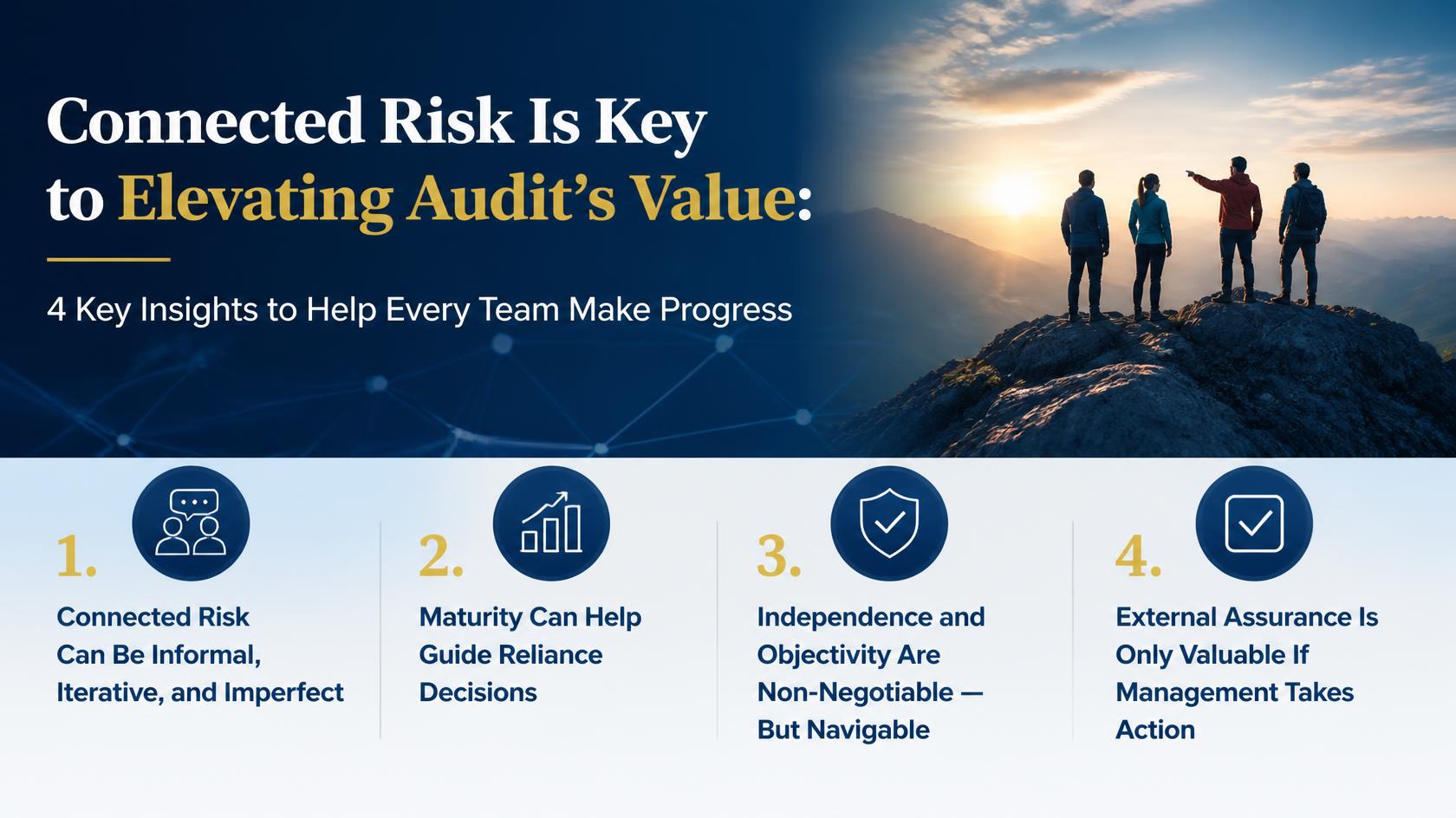
Connected Risk Is Key to Elevating Audit’s Value: 4 Key Insights to Help Every Team Make Progress

Want to be updated as new blog posts are released? Subscribe to our newsletter.
Join 1K+ readers of The Enabling Positive Change Newsletter for tips, strategies, and resources to improve your approach to Internal Audit and SOX compliance.