Why AI Governance Is Central to Internal Audit’s Relevance in the AI Era

Many Internal Audit teams have already done their first AI governance reviews. But more haven’t.
These teams feel overwhelmed by all the new AI frameworks and guidance. They’re unsure where to begin — and whether they know enough to do it.
They’re also overwhelmed by the work already on their plates, watching their workloads expand even as their budgets and headcounts shrink.
But here’s the big picture: AI is the defining business topic of our time, and effective AI governance must be a priority for every organization.
If your Internal Audit team isn’t looking at AI governance, you’re not fully addressing your organization's key risks — and you’re missing a key opportunity to ensure your team’s future relevance and value.
We understand the overwhelm. That’s why we did the legwork to pull together lessons learned, example project scopes, and more from peers who have already done this work in the Internal Audit Collective’s new eBook. Download the complete eBook today, and read on for more insights on why AI governance is central to ensuring the future of our profession.
Five Truths Illuminating Internal Audit’s Path to Relevance
We created the Internal Audit Collective’s new eBook, The AI Governance Playbook for Internal Audit: A Practical Guide to Providing AI Assurance and Advisory Services, because of five impossible-to-ignore truths:
- AI is changing how work gets done. It is changing operating models, impacting workforces, and creating new threats and opportunities daily. Its use and impact will only grow.
- Our remit is expanding as our resources are declining. Internal Audit has to do more with less. AI is core to achieving that, and to helping us evolve our role/scope to better meet the needs of the business.
- AI’s strengths and weaknesses will help define Internal Audit’s strengths and weaknesses. AI will take on much of the backward-looking assurance work that has been our traditional bread and butter. Staying relevant and providing value requires us to focus less on hindsight, and more on insight and foresight. It also requires us to cultivate and showcase the curiosity, critical thinking, ethical judgment, relationship-building and communication skills, and knowledge of real-world context only human auditors can provide.
- Internal Audit’s ability to credibly advise organizations on AI is vital for ensuring our profession’s future relevance. As AI becomes more embedded in our organizations’ processes, controls, and business models, guidance and assurance around AI use and governance become indispensable to business success and resilience. If we leave this work to the consultants, why do they need Internal Audit?
- We can’t advise on AI use/governance if we don’t understand it. We must develop the internal expertise to manage AI’s risks and responsibly capitalize on its potential — the end goals of effective AI governance. This expertise is essential for earning and maintaining trusted-advisor status in the age of AI.
Internal Audit’s Vital Role in AI Governance
Boards, executives, and employees are tasked with using and governing AI responsibly. Internal Auditors have a genuinely critical role to play in ensuring that AI delivers value while remaining trustworthy, ethical, and compliant.
Internal Auditors have traveled this road before.
“We’re starting to see AI follow a path similar to what organizations experienced with SOX and ITGCs years ago,” observed IT Audit Manager Oscar Macias in an Internal Audit Collective post. “At first, the focus is on adoption and capability. Eventually, the conversation shifts to governance, accountability, risk management, and controls.”
This is where we are now — and this is our time to shine.
We are uniquely qualified to do this work given our independence, objective perspective, strategic risk mindset, innate curiosity, critical thinking skills, cross-functional business knowledge and relationships, and risk, controls, process, and change management expertise. By embracing these strengths and combining Internal Audit’s core and adjacent roles, we can position ourselves as the trusted, strategic AI partners who will help our organizations ensure responsible, sustainable, value-producing AI use and governance.
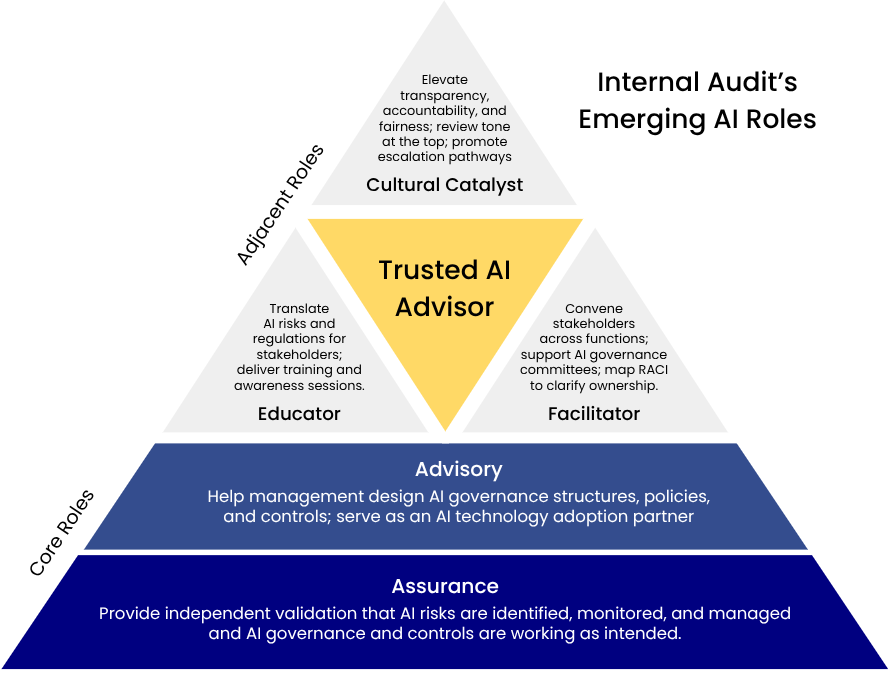
Internal Audit’s New Integration Imperative: “Connecting the Dots” on AI Governance
Our value and effectiveness in supporting AI Governance risk hinges on our ability to help integrate operational management’s technical safeguards with governance, risk, and compliance oversight structures.
Often, first-line teams operate in silos, and second-line teams lack expansive coverage across the organization. But Internal Audit — experienced in auditing and advising on the key processes and controls of both first- and second-line teams — can help connect the dots on AI governance to identify gaps, weaknesses, and improvement opportunities.
Internal Audit’s role is to challenge and strengthen the first two lines while avoiding duplication of effort. An integrated approach helps ensure accountability, avoid blind spots, and deliver coordinated assurance to boards and regulators, helping sustain trust in AI systems.
Integrated Assurance Roles for AI Governance
- First-Line Operational Management: Owns AI design, deployment, monitoring, and remediation. Internal Audit assesses whether training, data validation, anomaly monitoring, and disaster recovery cover AI risks.
- Second-Line Risk and Compliance: Builds AI risk frameworks, policies, compliance monitoring, and transparency requirements. Internal Audit reviews comprehensiveness, enforcement, and regulatory adaptation.
- Third-Line Internal Audit: Independently audits AI development, validation, and operations; tests security, ITGCs, ITACs, and business resiliency; and reports to the board on AI governance maturity. In addition, where first- and second-line activities are not in place or falling short, Internal Audit has the opportunity to act in an advisory and consultative role.
THE LAST WORD: It’s Time to Take the Lead on AI Governance
Are you ready to lead from the front of your organization on this once-in-a-lifetime business risk and opportunity?
You are readier than you think.
As The AI Governance Playbook for Internal Audit repeatedly stresses, Internal Auditors were born to do this work. It both leverages and showcases our strengths.
Beyond that, AI governance work is the best path I know to positioning Internal Audit as a valuable, relevant leader and business advisor now and in the years to come.
Commit to helping your organization move forward on the path to AI governance maturity: Download the complete eBook today. It’s packed with your peers’ first-hand, real-world knowledge of what works — and what doesn’t — in AI governance reviews.
In my not-so-humble opinion, Internal Audit’s relevance truly does depend on it.
Subscribe to the Newsletter
Join 23K+ readers of Enabling Positive Change Newsletter for tips, strategies, and resources to improve your Internal Audit & SOX Compliance skill set.