How to be a Better Leader to Your Internal Audit Team

What sets a top-tier CAE apart? What specific things are they doing differently?
This summer, I ran a survey* to find out — and the answers were simpler than I expected.
Truly, none of this is groundbreaking. It all seems pretty dang obvious when hauled out into the light.
But as I’ve shared these findings in webinars, roundtables, and one-on-ones, I keep hearing the same thing from CAEs: “I know these things are important. I know I need to allocate more time. I just haven’t been able to do it yet.”
Part of the reason? They need to figure out how to do it.
Well, our seven survey findings tell you how top-tier CAEs do it. Today’s article is on findings 5 and 6: two simple ways to be a better leader to your team. (ICYMI, findings 1 and 2 help you be a better leader to the business.)
Finding 5: How to Manage to Individuals’ Motivators
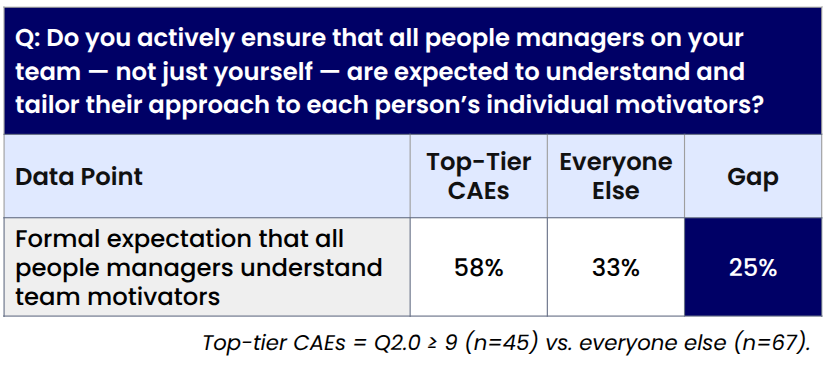
Top-tier CAEs require their managers to understand and manage to individual team members’ “motivators.”
- While every CAE has to ensure work gets done, top-tier CAEs aren’t just pushing their team with practical questions like “when will it be done?”, “what’s the status?” or “what’s keeping you from finishing?”. They’re also tailoring their leadership approach to fit what motivates each individual team member.
- To do this, they themselves work to understand what motivates each person on their team — and set the expectation that the team’s other people managers do the same.
- As the table shows, “average” CAEs may do this as well. Top-tier CAEs just do it more often.
‹
How to Get to “Great”
Many CAEs struggle to get their staff and seniors to really lean in on audit projects — to move beyond being basic check-the-box auditors. Appealing to individual motivators can be a game-changer.
It’s not rocket science: Different people need different leadership approaches to help them feel engaged, challenged, appreciated, and successful.
Reflect on the past 10–15 times you asked a team member to get X done by Y deadline. In how many situations did you provide context helping them understand not only why the task matters to Internal Audit and the wider organization, but also to their individual best interests?
In situations where you helped individuals see what’s in it for them, chances are there’s a correlation to better work (e.g., higher quality, done faster, more enthusiasm/initiative).
We tend to assume everyone’s on the same page about why something is important. If we make those assumptions and don’t keep individual motivators top of mind, we can (1) miss opportunities to engage our team members and/or (2) come across badly, actually making them less excited to do the work.
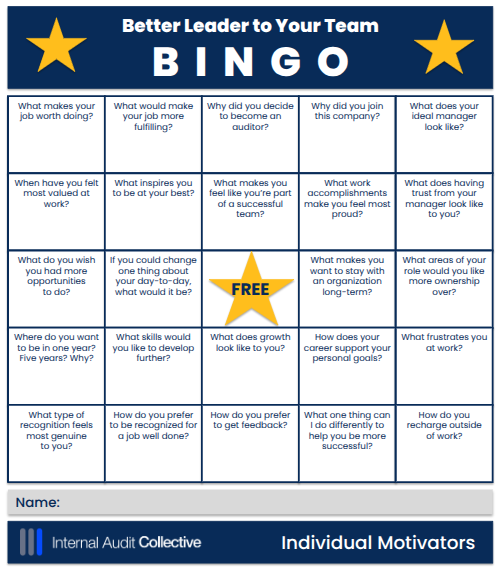
That’s why top-tier CAEs are more likely to ask questions that help them understand how each person is best motivated. For example, you can ask:
- “What makes your job worth doing?”
- “Why did you decide to become an auditor?”
- “Where do you want to be in one year? Five years? Why?”
- “What inspires you to be at your best?”
- “Why did you join this company?”
- “What areas of your role would you like to have more ownership over?”
- “What makes you feel like you’re part of a successful team?”
- “What is something you wish you had more opportunities to do?”
- “When have you felt most valued at work?”
- “If you could change one thing about your day-to-day work, what would it be?”
What does this look like in practice? During a recent one-on-one, an audit senior shared that they wanted to expand their network and build their reputation within the company. So when the CAE needed to staff a new, non-routine, high-priority audit project, they assigned the ambitious senior — and told them exactly why. The CAE said:
“We put you on this project because you want to build your network and reputation. Not only is this an important project for our Internal Audit team, but it will also give you face time with several prominent executives you expressed a desire to get in front of. So, to make sure we’re both putting our best foot forward, I’m hoping you can spend more time researching and ideating on the scope of this audit, and come ready to share some external perspectives on what great looks like for this process.”
You know that senior will at least TRY to knock it out of the park.
How to Get Started
- Seek to understand each person’s “why.” This can happen during the interview process, onboarding, or general conversations. These are all opportunities to (1) understand what’s in it for them, and (2) tie those goals back to their work. Along those lines…
- Treat one-on-ones as more than status updates. We all have so much on our plates, so it’s easy to default to using one-on-ones meetings as status updates. But that approach focuses on understanding the work, not the individual — and the work will be better if you use one-on-ones as regular opportunities to understand how each team member is doing and why.
- Proactively set expectations that one-on-ones aren’t about the work, but about THEM. Otherwise their likely default will be over-preparing their status updates.
- Make individuals’ motivators part of the leadership conversation. Set the expectation with every manager on your team: They are responsible for understanding and managing toward individuals’ motivators.
- Follow up. Check whether managers are following the practice as you’d check any other expectation: Ask managers directly; don’t just infer from morale surveys.
Finding 6: How to Level Up Team Recognition
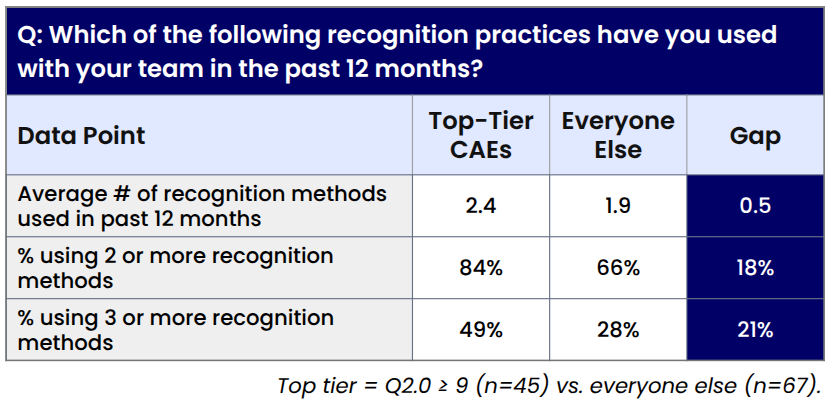
Top-tier CAEs tend to use multiple methods to recognize their team members.
- While “average” CAEs also reported using multiple methods, on average, top-tier CAEs tend to use more ways to recognize top performers. They don’t rely solely on one method (e.g., cash bonus, or public recognition, one-on-one “attagirl” or “attaboy” conversations).
- Possible survey responses included public recognition (team or company-wide); visible advocacy for promotions; formal recognition/awards program; and spot bonuses or spontaneous rewards. But as you’ll see below, many top-tier CAEs get even more creative.
In other words, top-tier CAEs often have more arrows in their quiver in how they’re recognizing employees. Over time, this helps their teams build camaraderie, collaboration, and a culture in which spotlight-sharing and positive feedback become the norm.
How to Get to “Great”
Digging into what this looks like in practice, I’ve heard a few noteworthy themes:
- They tailor the recognition to fit the situation — and person. For example, while public recognition on a company-wide call may be one person’s holy grail, another may shy away from it, feeling more appreciation from a one-on-one conversation. So it helps a ton if you’ve implemented finding 5 (above), so you start from a real understanding of what makes each person tick.
- They use different types of recognition at different levels. This roughly breaks down into four buckets: (1) within Internal Audit, (2) the wider Finance department, or (3) overall organization, and (4) personal/one-on-one.
- They get creative. During a CAE Leadership Forum roundtable on the topic, I was super-impressed by the quality and range of the recognition methods CAEs shared.
Below are ideas and tips for implementation, collected from one-on-one interviews with CAEs, that CAE Leadership Forum roundtable, and other conversations.
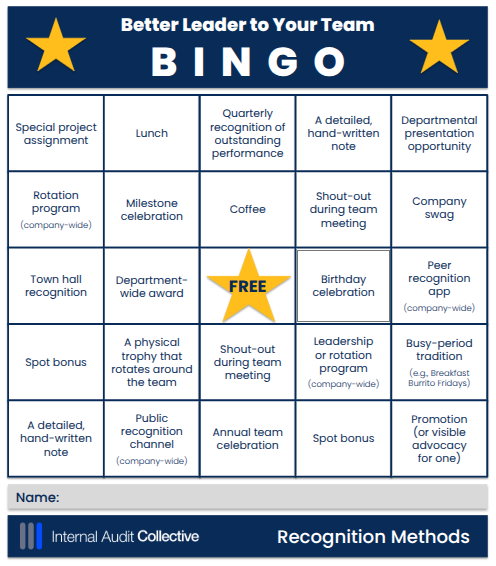
Recognition Methods
- WITHIN INTERNAL AUDIT:
- Promotions (or visible advocacy for them)
- Shout-outs during team meetings
- Quarterly recognition of outstanding performers
- Spot bonuses
- Spot travel awards
- Company swag
- Milestone and birthday celebrations
- Busy-period traditions (e.g., one CAE has “Breakfast Burrito Fridays” when the team is working particularly hard, with the CAE bringing the burritos)
- Annual celebrations, connecting a team event with an activity that helps people get to know each other on a personal level (e.g., during their annual SOX celebration, CAE Jim Wilson’s team guesses who anonymously submitted which favorite songs)
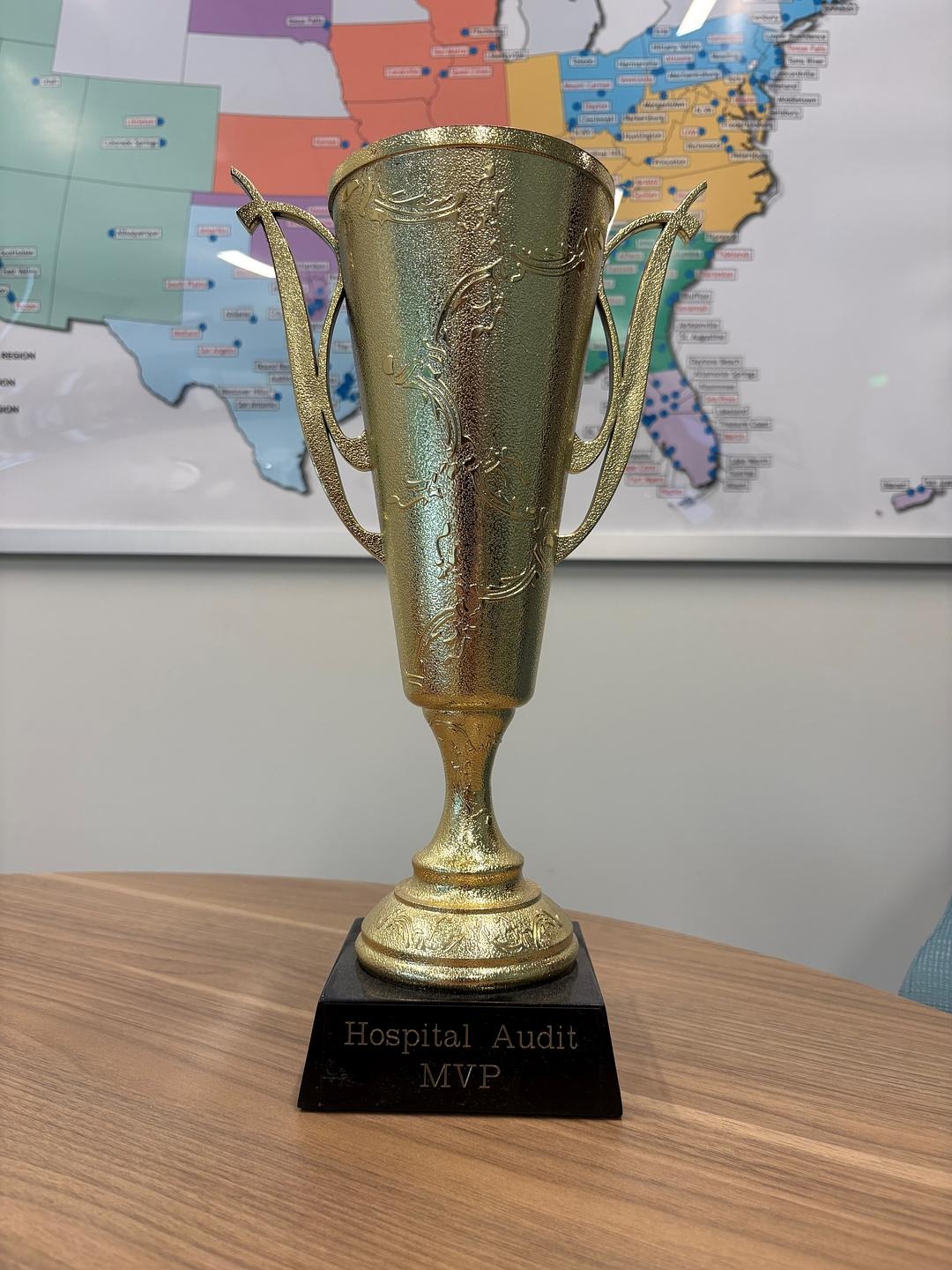
- A physical trophy that gets passed around, as in CAE Dean Taggart’s team, which has a “Big-Ass Trophy” that gets passed around to recognize good work (photo below!)
- WITHIN THE LARGER DEPARTMENT (e.g., Finance):
- Town hall recognition
- Special project assignments
- Opportunities to present (e.g., leading-practice approaches, recent successes, case studies, AI use cases)
- Department-wide awards (e.g., SOX Compliance Leader Jason Winter’s global Finance organization ties departmental awards back to the organization’s values, recognizing people who go above and beyond in demonstrating the values)
- COMPANY-WIDE:
- Leadership program (e.g., during my tenure, EY awarded new managers with week-long leadership programs in Florida that helped them develop new skills and relationships while enjoying a full week away from their day-to-day)
- Rotation program, like CAE Tom Sanglier’s “SWAP” rotation program, which allows auditors to switch places with someone in a different function for six- to nine-month rotations, building business acumen, relationships — and a staffing pipeline
- Public recognition channels on Slack or Teams (e.g., CAE Jillian Edgar’s company has a “Good News” channel on Teams where people share shout-outs company-wide)
- Peer recognition apps like Bonusly or Kudos (e.g., when I was at AuditBoard, everyone got a set number of recognition points they could use to recognize others with public high-fives and point-based awards; recipients could save up points and choose their own reward)
- PERSONAL/ONE-ON-ONE. Sometimes a more focused scope can actually make a bigger impact. For example, consider:
- A detailed, hand-written note. Call me old-school, but when I gave my team members a handwritten note, it often went the furthest. So if all else fails, consider the holy grail (or “big-ass trophy”) of recognition methods, a personal note. Not an email, but rather an authentic, specific thank you that you yourself take the time to write. The note’s style should match your own, whether that means a carefully chosen card or a simple post-it.
- Lunch or coffee. Think a CAE can’t grab coffee with a particularly hard-working staff or senior? Think again, because that staff or senior absolutely will feel seen and valued.
How to Get Started
Don’t wait. Just start. The goal is operationalizing recognition as part of team culture. To that end:
- Don’t rely on a single lever for recognition. The data pattern isn’t about doing one thing well — it’s about doing more than one thing.
- Make it a habit. For example, for me, there’s no better use for a Friday afternoon than gratitude, whether that means walking the halls, giving shout outs, or taking someone out for coffee.
- Make it genuine. Draw on your experience, and be open, honest, and vulnerable. For example, why not compare your team’s “A Game” with what you’ve seen and heard at past companies or across the wider industry? Or even with your own career and learning curve?
- Audit which methods your team uses. What has worked well? What has been lackluster?
- Get creative about improving. Thinking about team members’ individual motivators, what new recognition methods are worth experimenting with?
Need Help Getting Started? Play Bingo!
To make this even simpler (and more fun), Heather and I created a downloadable bingo card:
- One side keeps track of what you know about someone’s motivators. The other lists different recognition methods.
- Print out one for each team member. Take credit for what you’ve already done and learned — and as you get to know them better, cross off more recognition squares and add notes about who they are and what they’re working toward.
- By the end of 2027, make sure you’ve made progress on both sides. What could be simpler?
The bingo card is obviously optional. What’s not optional: REMEMBERING to do these two simple things to help you be a better leader to your team, and making them a priority.
What do you need to help you remember? Do that.
THE LAST WORD: You Can Win at Being a Better Leader to Your Team
“Life is what happens when you’re busy making other plans.” We’ve all heard the quote, which John Lennon may or may not have said.
But you get my point: Enough with the planning. Do something. Simple changes can yield big results.
If you’re hiring the right people, understanding what motivates them, and making them feel seen and valued, attrition will be lower. When attrition is low, your team has more time and bandwidth to dig deeper into the work that matters most. But the reverse is also true: High attrition generally leads to more burnout, less time to invest in your people, and even greater risk of attrition.
Also, this advice isn’t just true for audit — it’s true for life. And a big part of life is developing and maintaining good relationships, both from a personal and professional perspective.
So in 2027, let’s all make it a point to be a better leader to our teams. It really can be as simple as paying more attention to what motivates people and honoring that in creative, positive ways.
* CAE Benchmarking Survey Methodology and Analysis: The Internal Audit Collective’s survey was open to CAE-level Internal Audit Collective members from July 14 to August 3, 2026. We received 114 total responses representing a range of industries and team and company sizes. The 60 questions focused on how CAEs interact with business leaders, their teams, and the profession at large, as well as on their teams’ operational infrastructure. We defined “top-tier CAEs” as those who self-assessed as either 9 or 10 on a 1–10 scale across all domains. We compared top-tier CAE data with all other respondents’ data.
Subscribe to the Newsletter
Join 23K+ readers of Enabling Positive Change Newsletter for tips, strategies, and resources to improve your Internal Audit & SOX Compliance skill set.